💎 Hidden gems remaining: 6
Bundi is a smaller rural town where tourists are rare. Wherever we came, they all looked and waved at us with greatest joy and smile on their faces 😃! They often asked us what our name was or where we came from. However, this was all of English they spoke. Language barrier was the main determinator of the prices of tuk-tuk rides. Why? Because the only word they knew was "hundred". This made it a fixed price of 100 rupees for whichever destination.


As per tradition, we marked different points of interest on Google Maps upon the arrival. Despite many different attractions, it was not long before we stood in the Garh palace in disbelief, seeing a third of our markers located inside the same complex. Locals realy like their pins I deduct. The fort spans over a vast area on the hill, backside to Bundi. It was protected by a short wall, which now marks the monkey 🐒 territory.
Boring and standard yellow-ish on the outside, the palace comes to life with its interior. Bundi is known for blue tint architecture, which is greatly represented in both palace decorations and authentic city buildings as well. The higher you climb inside the fort, more smelly and wild the atmosphere becomes. You are slowly invading into self-claimed monkey territory. At first seeing those cute little beigns may press onto your cutness nerve, but soon you find yourself in the middle of prim(at)e conflict, and you really want to escape this as soon as possible. Rabbies is a real thing, and hospitals are non-hospitable at best if even existant in certain areas of India.

Dry frescoes. (Čarna, correct us if we're wrong!)

Like a boss.
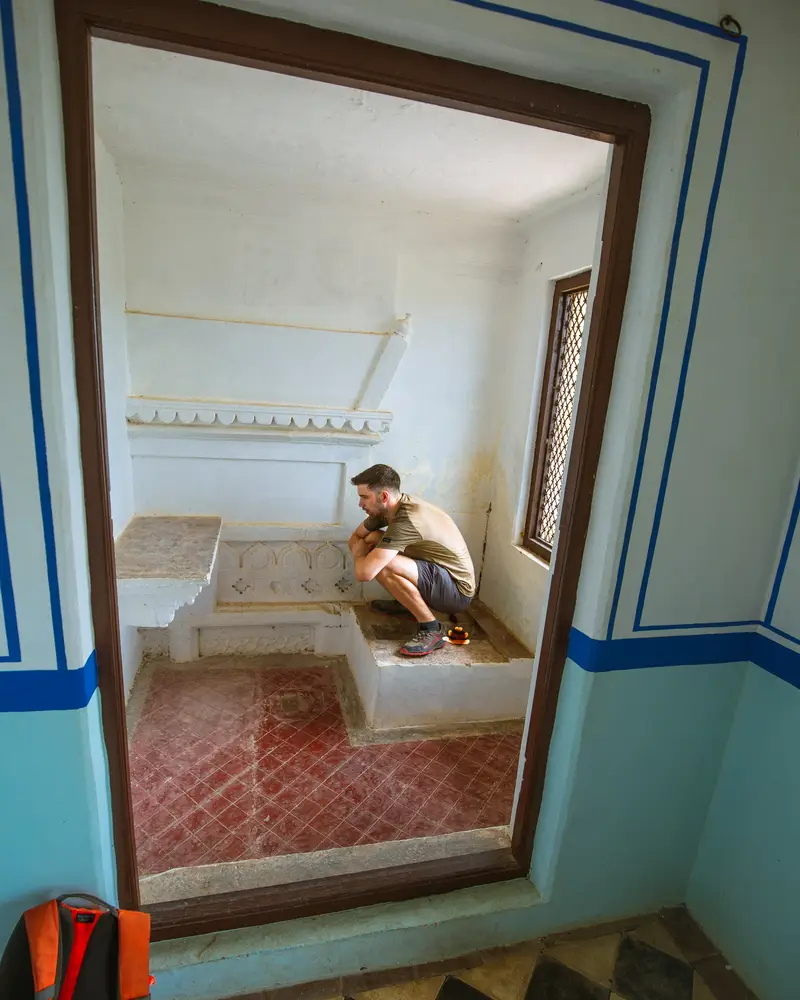

Push to poop.
The whole nexus is situated at very different height levels. When you reach one, there's another one, just a "short" hike away. Well, some hikes are shorter than others, to say at least. There's a garden nearby with mazes inside walls (mind your head, gates are small). At the top-most top, there's an abandoned castle with a scenic view over whole Bundi.
We underestimated the amount of walking and we were very stupid to do it at noon. So don't be like us, don't do stupid mistakes all the time. In our defence, it doesn't help the monuments only open after 10 o'clock. Bizzare!

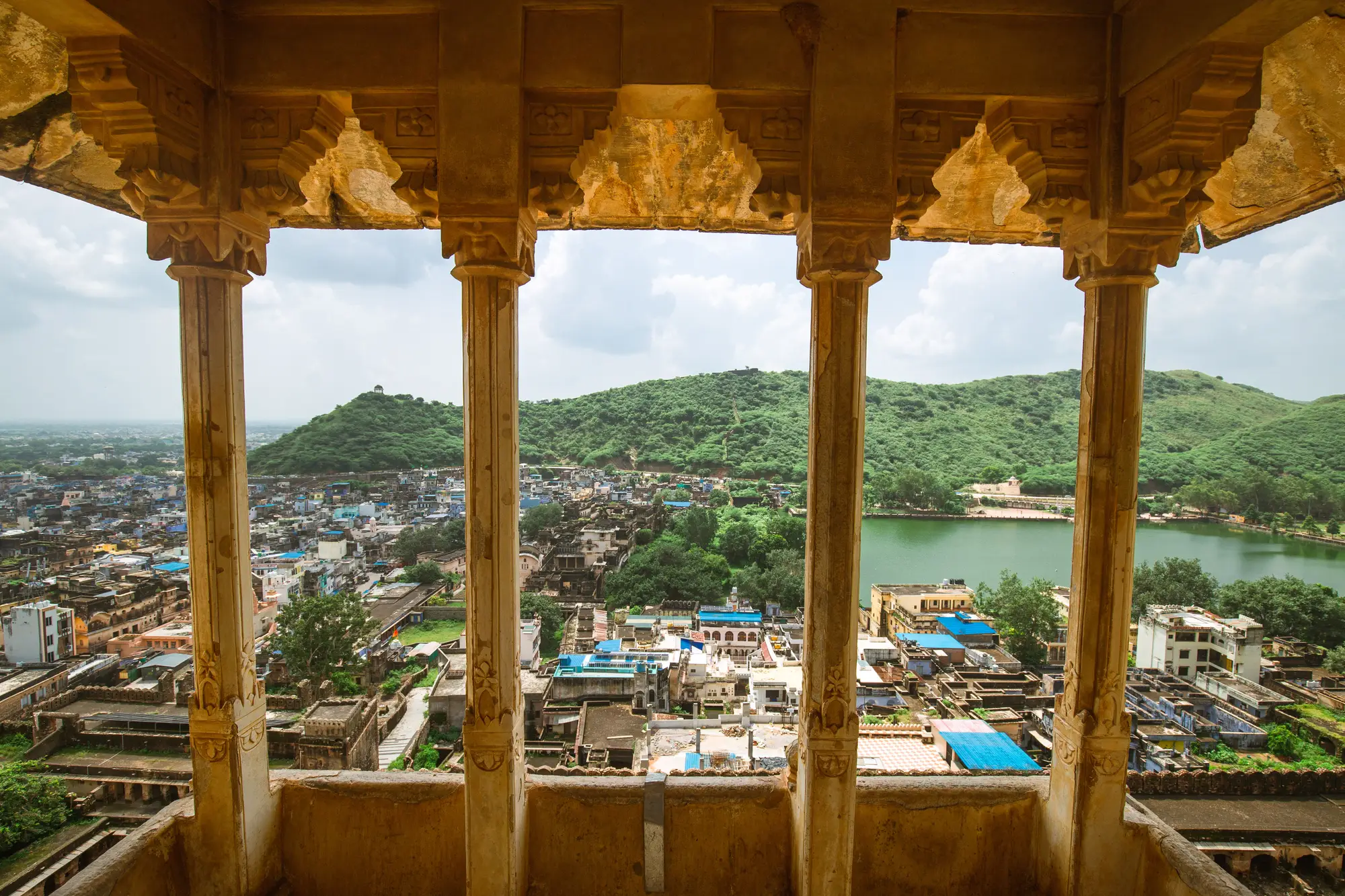
View from king's bedroom balcony. Bundy on the left, jungle in the middle, with algae overgrown step well on the right.
They must have been great water consumers in the past! Because in this teeny-tiny village (with only 1 million people), there are at least 3 step-wells! These are just as good at filtration as the ones in Jaipur, the water still toxically green. The most beautiful of them all, however, was Raniji Ki Baori. Ornaments carved with immense attention to details.
When we first saw it, we didn't even recognise it – because in all the photos we had seen, it was empty. Today, howbeit, it was half-full of blueish green water. It covered some steps, of course, but also some statues and gates. The reflection, on the other hand, made it nicely rounded.

Clean water in a step well, yet still undrinkable.
The original name is actually CENOTAPH OF 84 PILLARS. The building was carefully architectured 4 centuries ago with mythological motives. On the inside, you can find paintings and coloured frescoes. Again, the motives are diverse mythological.
Here, we must disappoint you: we didn't enter this area. Why? Because the ticket was too expensive and we are Carniolians. Just kidding! We came so early the Indians hadn't yet managed to open it! So we extended our long arms and took pictures through the fence.
Don't worry about the tickets – we bought the same composite ticket at the next attraction.

Carniolian version of sight-seeing
Despite bargainging for a fixed 100-ruppee price, we were released prematurely ... because a cop blocked us. We got cop-blocked. There was a Mawlid festival in the town, celebrating the birth of Mohammedd. Hence, the road was closed and we had to proceed being foot-goers. It was just half a two kilometres away. In the morning, the road was cool and shady. On the way back, however, Marko exhaled.
The sukh mahal is quite sad: small, nothing special. The dream of mirror-like lake vanished as soon as we glared into it, for lotos was spoiling the fotos. Nonetheless, we suspect it must have been nicer back in the days when the coast was still without houses, just trees leaning into their reflections. And as always in India, there must be a museum inside – this one was all-in-one: about armoury, paintings and statues.
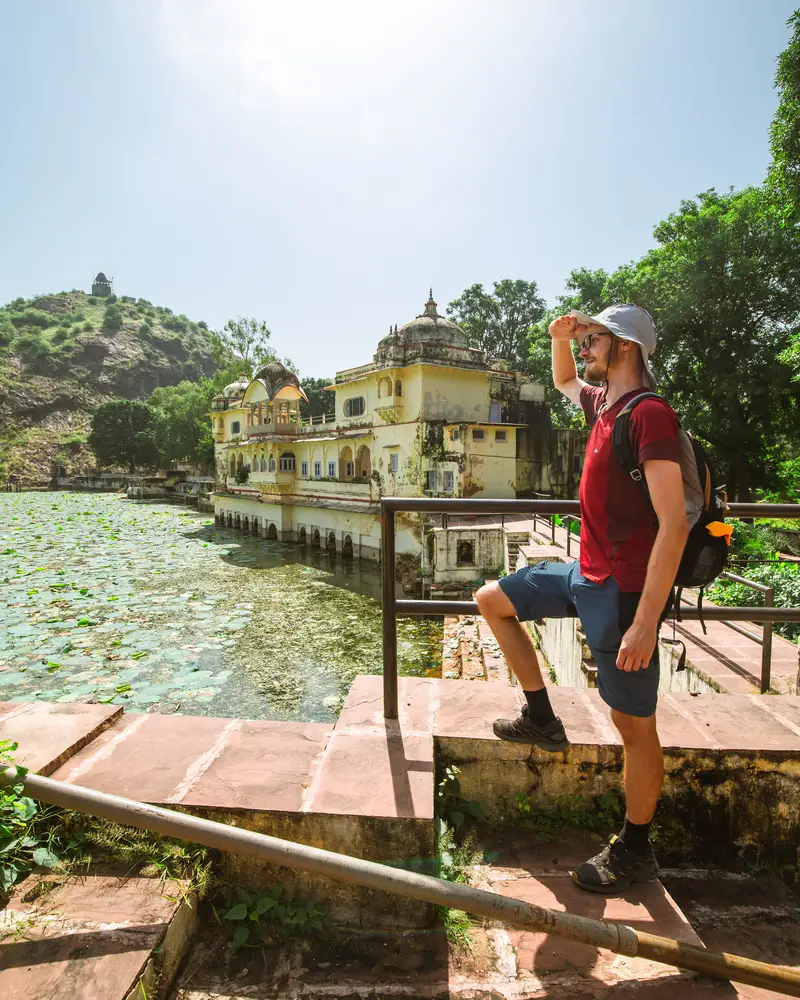
Look, a lotos!

In front of the museum. Official government of India!

It spoiled my photos 😢.
While we chose Bundi as a more authentic and rural Indian "village" – without disappointment –, we
forgot how this would impact our food options. As you may be familiar by now, we swore to eat in
middle-tier restaurant, which proved a little extinct in this area. So we were stuck with the hostel
restaurant which luckily offered a very diverse menu. After we tasted quite a big slice of their menu
(the paper is not really that delicious), we are pretty confident we can speak of the food quality.
Let's be honest here for a moment. The breakfast SUCKS here. You get
four options, none of which contains an egg. The only tasty meal are the cereal, but you will be more
hungry after the breakfast then before due to unreal waiting time. Come on guys, it is milk and cereal.
As for other meals, food tends to be delicious, but you should always ask them to prepare it non-spicy.
Even choosing this option will result in a moderately spicy dish, so I will leave the other option to
your imagination (yeah, it burns).
We have to admit we were very proud of the fact that the last day of Bundi coincided with a 5-day veggie streak. We really do crave some meat now.