
💎 Hidden gems remaining: 6
Jaipur has been a very remarkable landmark for us. Sadly we were unable to fully immerse in the picturesque "pink city", but that does not mean we did not remember it at all. Despite quite large population, Jaipur is quite a noiseless city (at least when compared to other monsters we have visited to date). The square-mandale layout of the old metropolitan area is now urbanised in unorganized fashion, with old city market converted to street vendors, selling same commodities at different rates and with just barely different shop fronts.


An European officer built this building who later decided to make it a sanctuary for local trades, crafts and art. The building itself is already a piece of art by itself as there are frescoes embedded in the ornamented walls. Details were left to local artists; thus, each room has a unique appearance. Even if it seems small from outside, you can quickly spend multiple hours and all your energy inside. Once out, you will crave a retreat to the Goodwin Retreat restaurant!
As seen in the photo, the pinky city is home to thousands and thousands of pigeons. They would change places in hoards, casting shadow on surroundings in the process.

Feed the birds, tuppence a bag
Due to the wind blowing through the gates, it is also known as The Wind Palace. A rare case of palace where the royal family still lives daily. Due to this fact, some parts may be closed for visitors at different times – depends what the members feel like doing that day.
Once we thought we'd escape the museums, five enchanting museums emerged from nowhere! In fact, in this palace, many rooms are dedicated to museums. First, armoury museum. Second, textile musem. Third, painting and photography museum (we entered this one through the wrong door, so we begun with recent photos and ended with manuscripts). Furthermore there was also a transport museum. Can you just give us a break? Cleary not. Maybe this was the reason we felt sick the next day...
To be honest we had different expectations from "the great" palace. Maybe we should have taken a overpriced royal tour, where you are allowed to peek inside monarchial saloons (and maybe spot a concubine).

Main square inside the palace.

The best navigator!
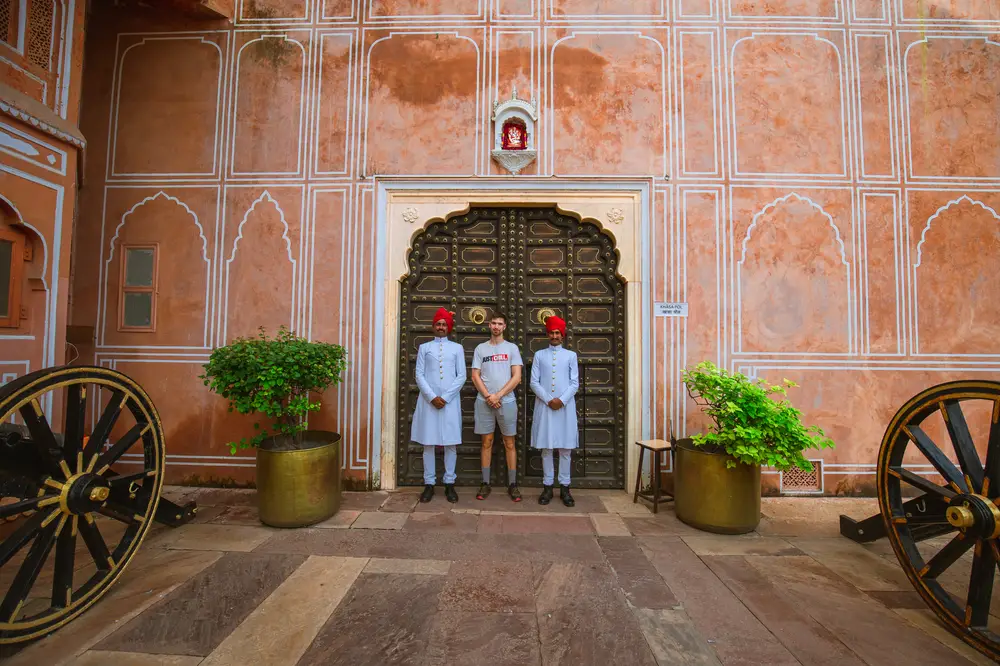
The prinz still lives here. We paid for this photo 💸.
Despite being located just at the edge of the city map-like, the actual road to the fort winds for good 15 kilometres. Or at least tuk-tuk drivers tell so. We have never experienced this road because all our attempts to book an Uber driver resulted in a cancelled ride as no one wished to take us there. At least not for 20 rupees. "My friend, no one takes you for 200. I make gud price and drive both for 800. Gud deal.". Being who we are, we declined the generous offer and rather exhausted ourselves on serpentines filled with cow feces. It reminded us of Slovenian mountain pastures. The scent of cowpat, not the unpleasant heat and barely survivable humidity. Nevertheless, we pushed through as we always do, being rewarded with 800 rupees in our pocket and an incredible photograph of the passage. Proceeding seeing the fort, we can say that the journey may have been more exciting than the result itself.


I wonder why there are so many organisms growing inside! (Click to purify)
Common in Rajasthani province, a step-well is said to hold purified rainwater. However, the results may make you think twice before drinking it. Water canals collected raindrops from the whole hill, delivering them through a set of purification facilities – similarly to how Romans cleaned water, the bottom- and top-most parts were discarded while the middle (clean) water was let through. Nowadays, the system must have a bottleneck! The spinachy colour and texture of the broth is further intensified by countless trash lying on every step. Žan, as a biochemist, declared this water undrinkable.
We had expected to find a mighty fortress at the top. However, it is more of a touristic selfie kerfuffle circus. To visit all buildings inside the ticketwall, you have to buy yet another ticket (they promise you a once-in-a-life-time-seen experience. Maybe because it is so bad you won't return to see it again? Idk, we didn't buy it). Inside the main fort, there was a fun and beautiful art installation. Big rocky balls (maybe representing planets) were put on green plastic chairs just waiting to break. The whole atrium was separated by mirrors under different angles – but all fit perfectly into the surroundings.
Half of the palace is dedicated to showcase local Indian artists who are no longer local – they gained enough money to flee the poverty into richer countries. The upper part was made into a maze (already at construction time) and you can easily get lost in circles. We fell victim to it, circling the same hallway eternally. Kind regards from the hallway. Marko is still wandering there. Žan shouted he was waiting at the rooftop!

Art installation. Mirror maze.

Selfie, as always (but this time not ours!)

Marko adoring the pink scaffold.

What's hiding in the bushes? A squirrel!
Not as mighty as Big Apples', still this central is mighty and very well groomed. Have we stayed more than 3 days, we could see ourselves having a picnic at one of numerous meadows, accompanied by friendly squirrels and nosy locals. Just make sure to bring your own supplies as contrary to other Indian parks, this one is not allowed to have vendors inside.
Besides the lawns, there are also children playgrounds (one even with a climbing wall), monuments resembeling world attractions, and most importantly a ginormous Inidan flag, risen on a hill at the center of the park.
We've been strong for 4 consecutive years, but our antennas failed on the 5th. Namely, while travelling, you are not immune to local diseases. Most likely, the rapid changes between hot & humid outside spaces and cold & dry insides, combined with not regularly cleaned air conditioning "finally" crushed us. Žan was lucky and not chained to the bed, but Marko wasn't and was stuck flat on his back (thank you, PONS, for this translation!). Concerned for our health, we called a doctor, who came and examined us and prescribed us medication, after which we felt ... better. And like elderly persons, with 5 different pills to eat at each meal.
"Now you listen to me", propheted the doctor, "your ears are like antennas. They detect rapid changes in temperatures. That's why you got sick. You have to cover them so they don't detect anything, – you understand?"
"I prescribe you: warm salinity soup, – curry – and warm coconut water. Do not eat bananas! Now I tell you why: – – we consider bananas – cold food. And cold fud is not gud. Also, don't drink tea! Tea contains caffeine, which will dehydrate you! That's why you have to drink warm coconut water," he preached to us. Amen, ata!
🍌 Bananas. Although the doctor forbade them, we had a whole bag of bananas we had bought just prior to his visit. Actually, it was something we felt like eating, had appetite for it.
But while healthy, we visited the Goodwin Retreat restaurant twice, ordering the same dish twice! It was that good! Aloo Gobi Adraki is a vegetable & potato dish, stir fried and nicely seasoned. Besides it, we once also tried non-spicy Dal Makhani, very good. Use the button below to find out more!