
💎 Hidden gems remaining: 8
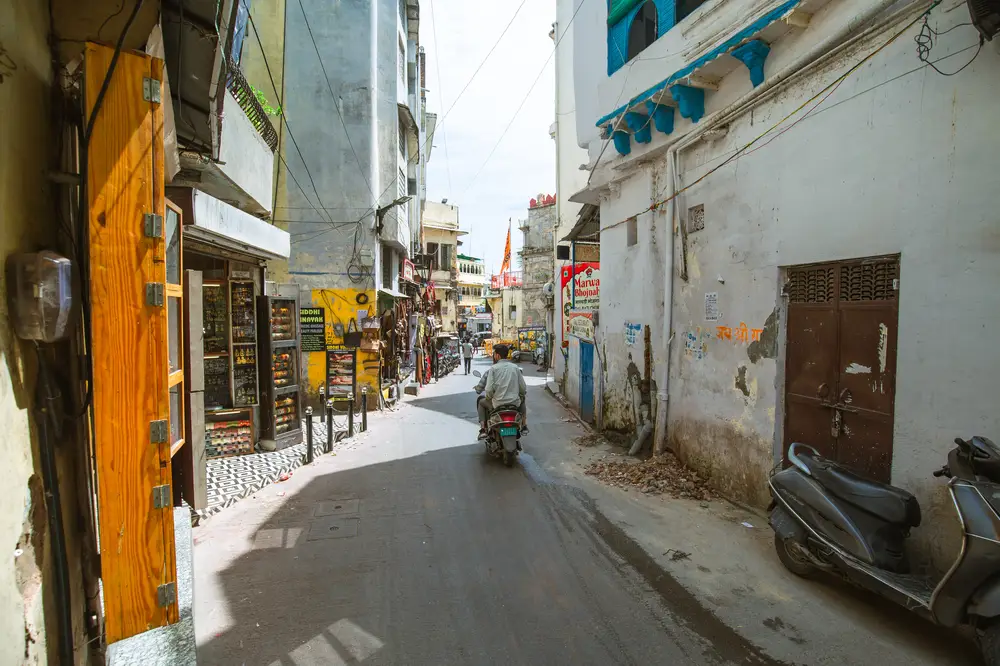
Without a doubt, this is the most touristic city in India. At least we saw the highest number of foreign tourists here. Also known as the City of Lakes, there are many water bodies spread all around. Some are even said to provide drinkable water (but the experience may vary). The winding streets full of clothing and jewelery shops remind us of Mykonos, albeit without strict blue-white colouring. Some tourists find the traffic here so non-chaotic that they even dare to rent a scooter here (which is, by the way, an outstanding deal at 200 rupees/day).


We call it "the Indian Bled". There are 7 lakes, 5 of which are major: Fateh Sagar Lake, Lake Pichola (said to have drinking water), Swaroop Sagar Lake, Rangsagar, Doodh Talai Lake. They have all been artificially built to provide water and beauty. In Asian world, a ghat is a coastal way to a river or a lake, without houses or other structures spoiling the access. It is also a great way to get bitten by mosquitoes! There are many fancy and less fancy coastal restaurants, many of them made by foreign standards (providing less spicy food and European looks). Funny thing: they are "recommended by Lonely Planet since 2011".

We crossed this bridge every day, multiple times a day.
The visit of the City Palace is recommended for the first day of your stay – and once you see it, you know why. It is huge and exhausting, but it provides a great outlook and a deep dive into the history of the city and the area. This palace used to be the governmental centre of the Mewar Kingdom but has been decommissioned by the reign of British Empire. Nowadays, it is privately owned by a family who decided to make it into a museum and provide two private hotels. Most of the profit is put into the fund for the well-being of the city. It is extremely well maintained and organised; it reminded us of the Ankara palace or Malta. Definitely worth a visit!
Pro tip: if eligible for student discount, go to the Manager Office first to verify your student ID. Else, you'll have to queue two times. (While Indians will be cutting the line at all times!)
This is also the embarking point for boats to the castle in the middle of the lake (is Udaipur copying Bled or did Bled copy Udaipur? 🤔)

Doing make-up in the bathroom of the castle (it is not a bathroom).

His teeth fell out. A big peacock.
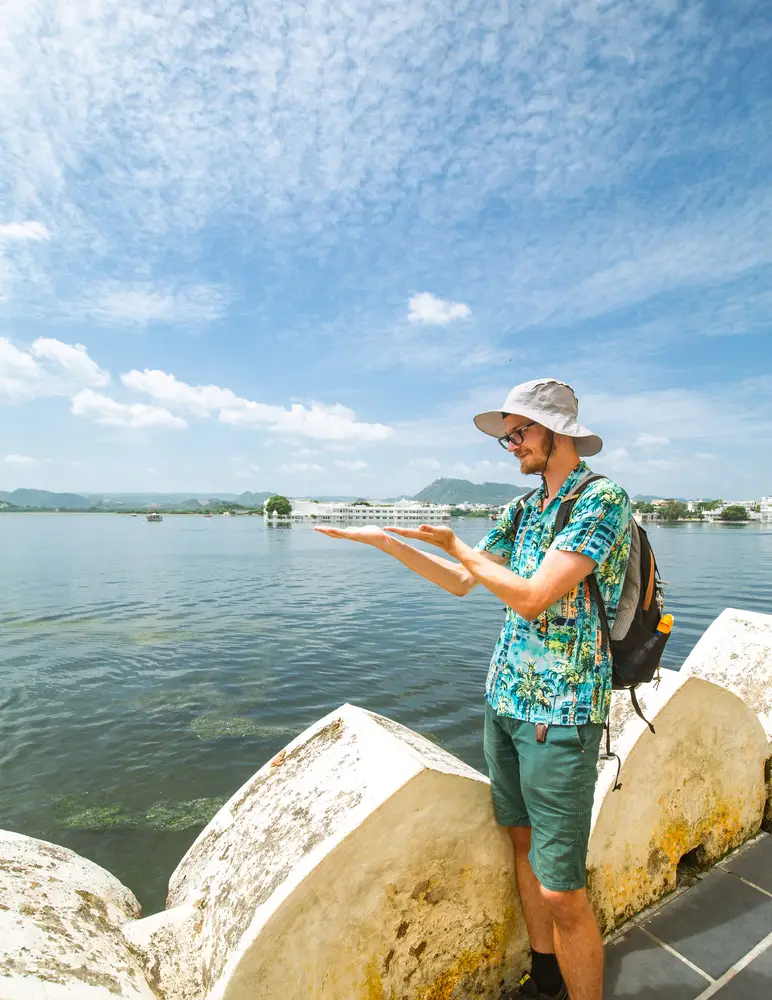
Carefully holding it in the hands!
Don't actually climb, you will strain yourself in the hot sun. The Monsoon Palace was built long ago with the intention to provide a lookout for the monsoon clouds (hm, I wonder how it got its name 💁). However, the king who began the job died at a young age of 25; his brother continued with a slightly different vision: to make an actual palace, a castle. It was somewhat shorter than originally imagined, so you couldn't have your thoughts up in the clouds. Later, they added a military defence tower. There is a viewpoint lookut providing an outstanding look of the two gigantic lakes and the city with 600 000 people. Also, you will see the oldest mountain system in the world!
Please note: a tuk-tuk can only take you to the ticket counter (which is at the bottom of the hill). From there, you need to buy an internal taxi for 120 rupees per person (bi-directional ticket) or walk 3,6 km uphill in the heat of burning sun. We were smart this time (but some other stupid young white people tried trying climbing it on thier own), and soon, we were densly packed in the trunk of a jeep, facing perpendicularly to the direction of driving. The roads are in an even worse condition than the old Medvode–Kranj line (before the renovation), or similar to the road to Kofce. Good tip: if prone to motion sickness, take your pills/chewing gums before the ride!

Relaxing on the viewpoint.

Local tourists listening to folk music.

Looking out for monsoon clouds.
Despite quite a walk away, this royal garden is a cosy visit when you finally tire yourself from museums or rather long walks because you won't spare some change for tuk-tuks. While entering the well-maintained garden, your attention will be immediately drawn to carefully laid out water fountains. Albeit, some of them have clogged nozzles that will make you wet when passing wrongly directed water jet (it does make for a great refreshment).

Watch out for squirting jets!

Beautiful as always.

Marko, what are you doing?
Walking distance from the garden, you can walk along the water promenade. Although there is some traffic, the views are beautiful. There's a whole food market with more than 20 restaurants, should you wish to endanger your health and try local street food. Like the camel did.

Camels eat curry, just as we do, to get used to spiciness and avoid cold food like bananas.

Indian chefs!
Ever since taking a cooking class in Thailand, it was on our to-do list for all our trips. Although we were trying to find one from the beginning of our journey already, we failed to do so. Finally, in Udaipur, we found actually existing cooking classes! To ease your search, we took Durga Cooking Class. If you walk through the city, you will find many advertising billboards for classes, but watch out as they provide very different experiences. Many of them will teach you how to cook only famous masala chai and one of the chosen (or even preset) main dishes, while we got to learn 7 dishes by heart. And we were able to choose what we wanted to make it even more appealing.
Spices and herbs are the central part of Indian cuisine. Thus, we were first shown two "golden boxes", respectively. Durga gave us an insight into how and when to use each of them, and we tested their aromas. Indiands treasure spices and herbs and believe that a dish without them is just an ash. And they really are a must for preparing a delicious food base. What you learn from the class is that the majority of the dishes start up the same – with a blend of spices and herbs, forming an orange curry-like paste. This is then upgraded into the final dish of choice by adding signature ingredients.
We were lucky to be the only ones taking this class, as this allowed us to cook everything and even make the chapati dough on our own. In contrast to the Thai class where everyone had their own cooker and dishware, the Indian class is all in one kitchen with one stove.
... because it doesn't work. We don't know whether it was broken or just there was no operator to turn it on. (Well, the electrical equipment seemed fried and overgrown with vegetation, just like the water was overgrown with algae.) But you can watch a beautiful sunset from a nearby lake shore!
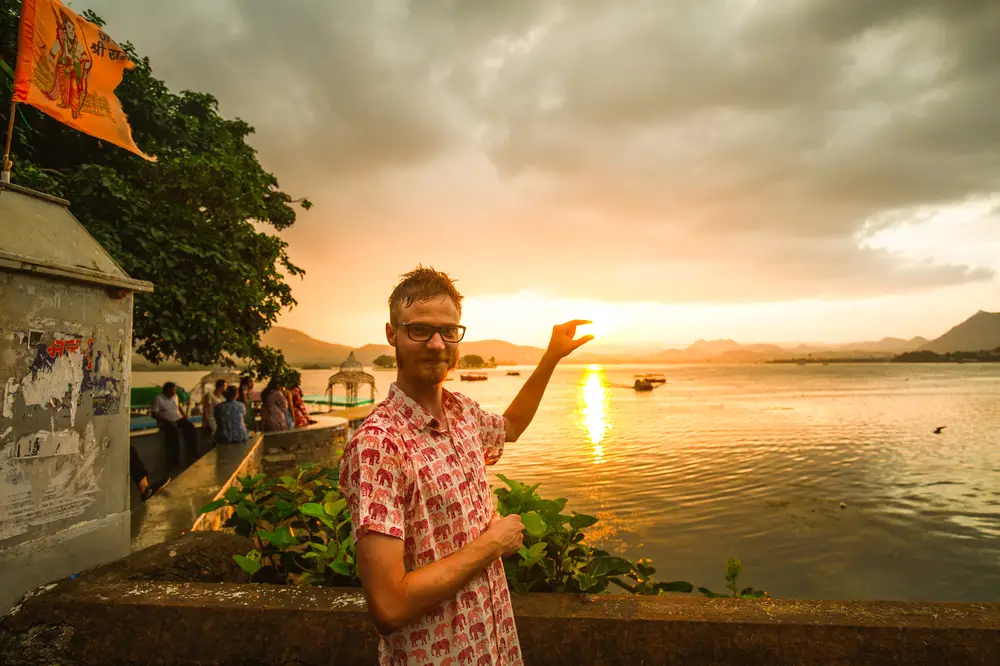
Žan holding the sun (it was bound to fall into the water! He saved the day 😂).
They provide authentic folk music experience. While not the most in sync and enthusiastic, it is still a must to discover Rajahstan culture. If you leave a tip at the end, maybe the performance will seem happier next time.
The show consists of multiple dances in colourful clothes, two puppet shows (incredible puppets!) and a "quick dancing class". All of it is accompanied by three locals playing drums, an accordion-like instrument and singing. If the producer didn't show them to hurry up, maybe the dancers could actually dance as swiftly as the music sounded. What we loved was that one drummer was scrolling his phone while playing (and missing the beat 😂) and two crew members just walking around the stage to switch on the lights and look ... in the air? 🤷😂 without the tiniest will of discretion.

Colourful clothes. Where's Waldo?

Colourful spices.
We know all your friends asked you to bring home some spices. Now is your time! There are local spice shops here where you can find everything you wish. To make it easier, here's one option. They cost on average 1 rupee per gram (except green cardamom which costs 4 rp/g).
We ate what we cooked! And also visited the Little Prince daily.
Our menu consisted of pakora (starter), which reminded us of the Thai dish No Name, and masala chai, which was actually good (the milk ratio contained was 1 : 1 with water and we avoided spicy chilly. By the way, you are not supposed to drink it more than 3 days in a row to avoid stomach problems). We continued with our favourite vegetable dish: Aloo Gobi (this means "potato cauliflower"), with a lentil soup (they called it "small chickpeas") called Dal Makhani, both of which were prepared in a pressure cooker. We added green peas rice (without cumin for we don't like much cumin) and different types of Indian bread. We made our own dough (Žan had an arm day 💪, no need for fitness!). You think you just bake the bread like a pancake? It is more exquisite: you remove the pan and some point and just put it into fire until it blows like a baloon! If you put garlic inside, don't try this or you'll finish with a garlich shrapnel bomb 🙈.

Making bread.

Aloo Gobi.

The result: roti, chapati with butter, garlic chapati.